If you are looking for a powerful Android smartphone, you have probably seen names such as Snapdragon 8 Gen 1, Snapdragon 8 Gen 2, Snapdragon 8 Gen 3 or Snapdragon 8 Elite mentioned in specifications.
But what exactly do these names mean? And does having a newer Snapdragon processor really make a smartphone better?
The processor or more accurately, the System-on-Chip (SoC)-is one of the most important components of a smartphone. It influences how quickly apps open, how smoothly games run, how efficiently the camera processes photos, how advanced AI features can be, how fast the phone connects to mobile networks, and even how efficiently it uses battery power. Qualcomm’s Snapdragon 8 Series is primarily designed for premium and flagship Android smartphones. Over the last few generations, these processors have become significantly faster, more efficient and more capable of handling AI, photography and console-style gaming.
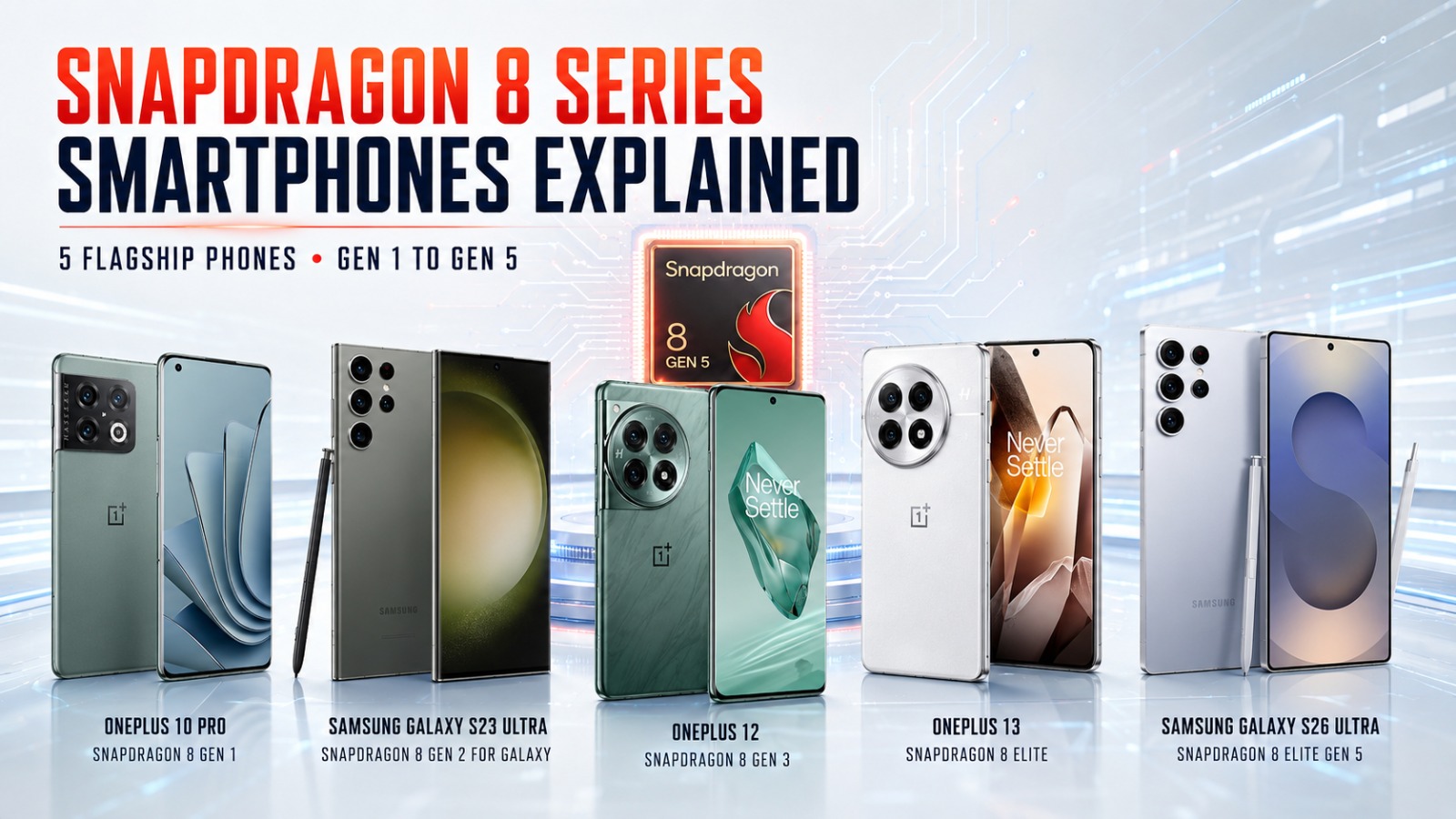
In this guide, we will look at five smartphones that represent the evolution of the Snapdragon 8 flagship family-from Snapdragon 8 Gen 1 all the way to today’s Snapdragon 8 Elite Gen 5.
First, Understand the Snapdragon 8 NamingThere is one important detail customers should know. Qualcomm originally followed a simple naming pattern:
| Generation | Flagship Processor | Representative Smartphone |
| 1st Generation | Snapdragon 8 Gen 1 | OnePlus 10 Pro |
| 2nd Generation | Snapdragon 8 Gen 2 | Samsung Galaxy S23 Ultra |
| 3rd Generation | Snapdragon 8 Gen 3 | OnePlus 12 |
| 4th Generation | Snapdragon 8 Gen 4 | OnePlus 13 |
| 5th Generation | Snapdragon 8 Gen 5 | Samsung Galaxy S26 Ultra |
You may notice that there is no flagship processor called Snapdragon 8 Gen 4 in this sequence. That is because Qualcomm changed the branding. The Snapdragon 8 Elite that followed Snapdragon 8 Gen 3 represents the next generation of its premium flagship platform. Qualcomm later explained that Snapdragon 8 Elite Gen 5 represents the fifth generation since the company introduced its newer single-digit naming system.
There is now also a processor called Snapdragon 8 Gen 5, announced separately in November 2025. It sits alongside the Elite family as another premium option, while Snapdragon 8 Elite Gen 5 remains the higher-end flagship platform.
With that cleared up, let’s look at five phones that show how Snapdragon flagship performance has evolved.
- OnePlus 10 Pro – Snapdragon 8 Gen 1
The OnePlus 10 Pro is a good example of the first generation of Qualcomm’s modern Snapdragon 8 naming system.
At its heart is the Snapdragon 8 Gen 1, a 4nm flagship processor designed to deliver high-end CPU performance, advanced mobile gaming, improved AI processing and faster 5G connectivity. Qualcomm equipped the platform with its Snapdragon X65 5G modem and an 18-bit image signal processor, while its graphics architecture delivered a substantial improvement over the previous Snapdragon generation.
What does that mean for a customer?
For normal everyday use, the OnePlus 10 Pro still feels like a powerful smartphone. Social media, video streaming, browsing, multitasking and productivity applications are easily within the processor’s capabilities.
The difference becomes more noticeable when performing demanding tasks. High-quality mobile games can take advantage of the powerful Adreno GPU, while the chipset’s image-processing capabilities help the camera process HDR images, video and computational photography.
The phone itself combines the Snapdragon 8 Gen 1 with a 6.7-inch 120Hz LTPO AMOLED display, up to 12GB LPDDR5 RAM, a 5,000mAh battery and a Hasselblad-developed camera system featuring a 48MP main camera, 50MP ultrawide and 8MP telephoto camera.
Who is it suitable for?
The OnePlus 10 Pro makes sense for someone who wants former flagship-level performance without necessarily buying the newest generation.
However, customers comparing older flagship phones should consider more than raw processing power. Battery condition, remaining software-update support, warranty and official availability can be just as important.
Generation takeaway: Snapdragon 8 Gen 1 established the foundation for Qualcomm’s modern flagship 8-series platform, offering strong gaming, camera processing and 5G performance.
- Samsung Galaxy S23 Ultra – Snapdragon 8 Gen 2 for Galaxy
The jump from Snapdragon 8 Gen 1 to Snapdragon 8 Gen 2 was particularly important because Qualcomm focused not only on making the processor faster, but also significantly more efficient.
Qualcomm states that Snapdragon 8 Gen 2 brought improvements including up to 35% faster CPU performance and 40% better CPU power efficiency compared with its predecessor, alongside faster graphics and hardware-accelerated ray tracing support.
A great example is the Samsung Galaxy S23 Ultra, which uses a customized Snapdragon 8 Gen 2 Mobile Platform for Galaxy.
Why is the Galaxy S23 Ultra still important?
The S23 Ultra demonstrates how a powerful processor can improve several areas of a smartphone simultaneously.
Its Snapdragon chipset does not simply make applications load quickly. It works together with Samsung’s camera system to process huge amounts of image data from the phone’s 200MP main camera, including computational photography and low-light Nightography processing.
For gaming, the powerful GPU allows demanding titles to run smoothly while the processor’s improved efficiency helps reduce unnecessary power consumption.
Samsung paired the processor with a large 6.8-inch QHD+ Dynamic AMOLED 2X display with an adaptive 1-120Hz refresh rate, a 5,000mAh battery, a 200MP main camera and two telephoto cameras offering 3x and 10x optical zoom. It also includes the built-in S Pen, making the phone suitable for productivity as well as entertainment.
Who is it suitable for?
The Galaxy S23 Ultra remains particularly attractive for: Mobile photographers Business and productivity users,S Pen users,Mobile gamers,Customers who want a premium Samsung flagship experience.
Generation takeaway: Snapdragon 8 Gen 2 demonstrated that better smartphone performance is not only about higher speed. Improved efficiency can mean smoother sustained performance and better real-world battery behaviour as well.
- OnePlus 12-Snapdragon 8 Gen 3
With Snapdragon 8 Gen 3, Qualcomm moved strongly into the era of on-device generative AI.
Qualcomm designed the chipset to support generative AI models directly on the smartphone and reported significant improvements to CPU, GPU and AI-processing performance. Its Hexagon NPU was designed for much more demanding AI workloads, while the Adreno GPU improved both graphical performance and efficiency.
The OnePlus 12 is one of the best examples of this generation.
What makes the OnePlus 12 interesting?
The phone combines Snapdragon 8 Gen 3 with up to 16GB LPDDR5X RAM and fast UFS 4.0 storage. That combination matters because the processor does not work alone. Think of the processor as the person doing the work, RAM as the workspace available to that person, and storage speed as how quickly information can be brought to the workspace. A powerful processor paired with fast RAM and storage creates a much smoother overall experience.
OnePlus also equipped the device with a 6.82-inch QHD+ 120Hz LTPO display, a 5,400mAh battery, fast wired and wireless charging and a camera system consisting of a 50MP main camera, 64MP periscope telephoto camera and ultrawide camera.
Where does Snapdragon 8 Gen 3 make a difference?
Customers are likely to notice its capabilities during:
Gaming: More demanding graphics and higher frame rates can be handled more effectively. Multitasking: Switching between heavy apps, games, editing applications and social platforms feels more responsive. Photography: Advanced computational photography can process images and different parts of a scene more intelligently. AI: AI-based image editing, language tools and other on-device intelligent features can run much more effectively.
Who is it suitable for?
The OnePlus 12 is particularly compelling for customers who prioritize performance, gaming, fast charging and strong specifications.
Generation takeaway: Snapdragon 8 Gen 3 marked the point where AI processing became one of the central features of flagship smartphone processors rather than simply an additional capability.
- OnePlus 13- Snapdragon 8 Elite
After the Snapdragon 8 Gen 3, Qualcomm made a major change. Instead of calling its next flagship processor “Snapdragon 8 Gen 4,” the company introduced the Snapdragon 8 Elite. One of its biggest changes was the introduction of Qualcomm’s custom Oryon CPU architecture into its flagship smartphone platform. The OnePlus 13 is a strong example of what this new generation offers. It uses the Snapdragon 8 Elite Mobile Platform with Qualcomm’s Oryon CPU and Adreno GPU, combined with up to 16GB LPDDR5X memory and UFS 4.0 storage.
Why does the Snapdragon 8 Elite matter?
The move to Qualcomm’s custom CPU architecture represented a bigger architectural change than the typical annual processor upgrade.For customers, however, the technical architecture matters less than the result. The goal is faster application response, stronger sustained performance, better gaming capability and more efficient AI processing. OnePlus complements the processor with a 6.82-inch QHD+ 120Hz LTPO display, a large 6,000mAh battery, and a triple-camera system featuring 50MP main, 50MP telephoto and 50MP ultrawide cameras.
That combination makes the OnePlus 13 especially interesting because it balances raw performance with battery capacity.
Who is it suitable for?
This generation makes sense for customers who: Play demanding mobile games,frequently multitask,edit photos or video on their phones,use AI-powered applications,want a phone that should remain powerful for several years
Generation takeaway: Snapdragon 8 Elite was more than a simple “Gen 4” upgrade—it introduced Qualcomm’s Oryon CPU to its flagship mobile platform and marked a major shift in Snapdragon’s performance strategy.
5. Samsung Galaxy S26 Ultra- Snapdragon 8 Elite Gen 5
At the top of the current Snapdragon flagship ladder is the Snapdragon 8 Elite Gen 5. Qualcomm launched the platform in September 2025 with its third-generation Oryon CPU, upgraded Adreno GPU and faster Hexagon NPU. Qualcomm reported a 23% graphics performance improvement and 37% faster NPU performance compared with the previous generation.
One of the most prominent phones using it is the Samsung Galaxy S26 Ultra, powered by a customized Snapdragon 8 Elite Gen 5 for Galaxy.
Why is this processor different?
Modern flagship processors are increasingly expected to handle AI workloads continuously. Instead of sending every AI request to a cloud server, more tasks can be processed directly on the smartphone. That can contribute to faster responses and enable smarter camera processing, real-time image enhancement, intelligent assistants and other advanced features.
Samsung says the Galaxy S26 Ultra’s customized chipset delivers improvements across CPU, GPU and NPU performance compared with the previous Galaxy S25 Ultra generation.
What else does the Galaxy S26 Ultra offer?
Samsung combines the processor with a 6.9-inch QHD+ 120Hz Dynamic AMOLED 2X display, a 5,000mAh battery, 200MP main camera, 50MP ultrawide camera, 3x telephoto and 5x telephoto cameras. The device also supports up to 16GB RAM and 1TB storage, depending on configuration and market.
Samsung has also increased its focus on thermal management. The S26 Ultra uses an upgraded vapor chamber system designed to move heat away from the processor more effectively during demanding gaming or AI workloads.
Who is it suitable for?
The Galaxy S26 Ultra is aimed at customers who want essentially everything a modern Android flagship can offer: High-end gaming,advanced photography and zoom,AI capabilities,productivity,premium display quality,S Pen functionality,long-term flagship performance
Generation takeaway: Snapdragon 8 Elite Gen 5 represents how modern smartphone processors are evolving beyond CPU speed. AI processing, graphics, camera computation, connectivity and efficiency are now equally important.
Snapdragon 8 Gen 1 vs Gen 2 vs Gen 3 vs Elite vs Elite Gen 5
Here is the simplest way to understand the progression:The important lesson is that a newer processor does not simply mean apps open a fraction of a second faster. Each generation improves several parts of the smartphone experience.
| Processor | Main Evolution | Example |
| Snapdragon 8 Gen 1 | Modern flagship foundation | OnePlus 10 Pro |
| Snapdragon 8 Gen 2 | Major efficiency and gaming improvements | Galaxy S23 Ultra |
| Snapdragon 8 Gen 3 | Strong focus on generative AI | OnePlus 12 |
| Snapdragon 8 Elite | New Oryon CPU architecture | OnePlus 13 |
| Snapdragon 8 Elite Gen 5 | Faster AI, graphics and next-generation flagship performance | Galaxy S26 Ultra |
CPU
The CPU handles general computing tasks such as opening applications, multitasking, browsing, processing documents and running the operating system. A faster CPU usually means a more responsive smartphone.
GPU
The GPU handles graphics. It is particularly important for gaming, high-refresh-rate displays, visual effects and some photo and video-processing workloads. Gamers should pay particular attention to GPU performance and cooling.
NPU / AI Engine
The NPU specializes in artificial-intelligence workloads. Modern phones use AI for photography, voice recognition, translation, image editing, assistants, search and many other features. This is becoming increasingly important in newer Snapdragon generations.
ISP
The Image Signal Processor, or ISP, processes information coming from the smartphone’s camera sensors. That is why having a 200MP camera alone does not guarantee better photography. The processor, ISP, camera sensor, lens and manufacturer’s image-processing software all work together.
Modem
The processor platform also influences connectivity. Newer Snapdragon generations include increasingly advanced 5G and Wi-Fi technologies, improving potential network speed, latency and connection efficiency where supported.
Does a Newer Snapdragon Processor Automatically Mean a Better Phone?
No. This is one of the most important things customers should understand. A processor is extremely important, but a smartphone should be evaluated as a complete package.
For example, Phone A may have a newer processor than Phone B, but Phone B could still offer:
- A better camera system
- A larger battery
- Better cooling
- A superior display
- Longer software support
- Faster charging
- Better durability
- Better after-sales service
Two smartphones using the same Snapdragon processor can also perform differently because manufacturers use different cooling systems, software optimization, RAM, storage and power-management strategies.
So customers should never buy a smartphone only because of the processor name.
Which Snapdragon Generation Should You Choose?
For normal everyday users, even Snapdragon 8 Gen 1 and Gen 2 devices can still provide plenty of performance for browsing, streaming, social media and common applications.
For gamers and heavy users, Snapdragon 8 Gen 3 or newer processors are more attractive because of improvements in graphical performance, efficiency and thermal management.
For AI-focused users and customers who want a phone for several years, newer Snapdragon 8 Elite-generation devices are the stronger choice.
For photographers, the processor matters, but camera sensors, lenses, optical stabilization and the manufacturer’s image-processing software should be considered equally carefully.
Final Thoughts
The evolution from Snapdragon 8 Gen 1 to Snapdragon 8 Elite Gen 5 shows how quickly smartphone technology has progressed.
Snapdragon 8 Gen 1 introduced Qualcomm’s modern flagship naming generation. Snapdragon 8 Gen 2 significantly improved efficiency. Snapdragon 8 Gen 3 pushed smartphones deeper into generative AI. Snapdragon 8 Elite introduced Qualcomm’s custom Oryon CPU architecture, while Snapdragon 8 Elite Gen 5 further expands performance, graphics and on-device AI capabilities.
But the most powerful processor is not automatically the best choice for every customer.