A complete guide to choosing the right winter water heating solution for your home
With winter approaching, most Bangladeshi households start preparing for warm baths, kitchen chores, and morning routines that rely heavily on hot water. But heating water is one of the highest electricity-consuming tasks in any home. So choosing the right water heater- Geyser (Storage Water Heater) or Instant Water Heater is not just about comfort, but also about saving money and energy.
This detailed guide explains how each type works, their electricity usage, family-size recommendations, practical scenarios, and which one saves more in real life depending on your lifestyle.
1. How Each Type of Water Heater Works (In Simple Terms)
Understanding how these devices function makes the comparison clearer.
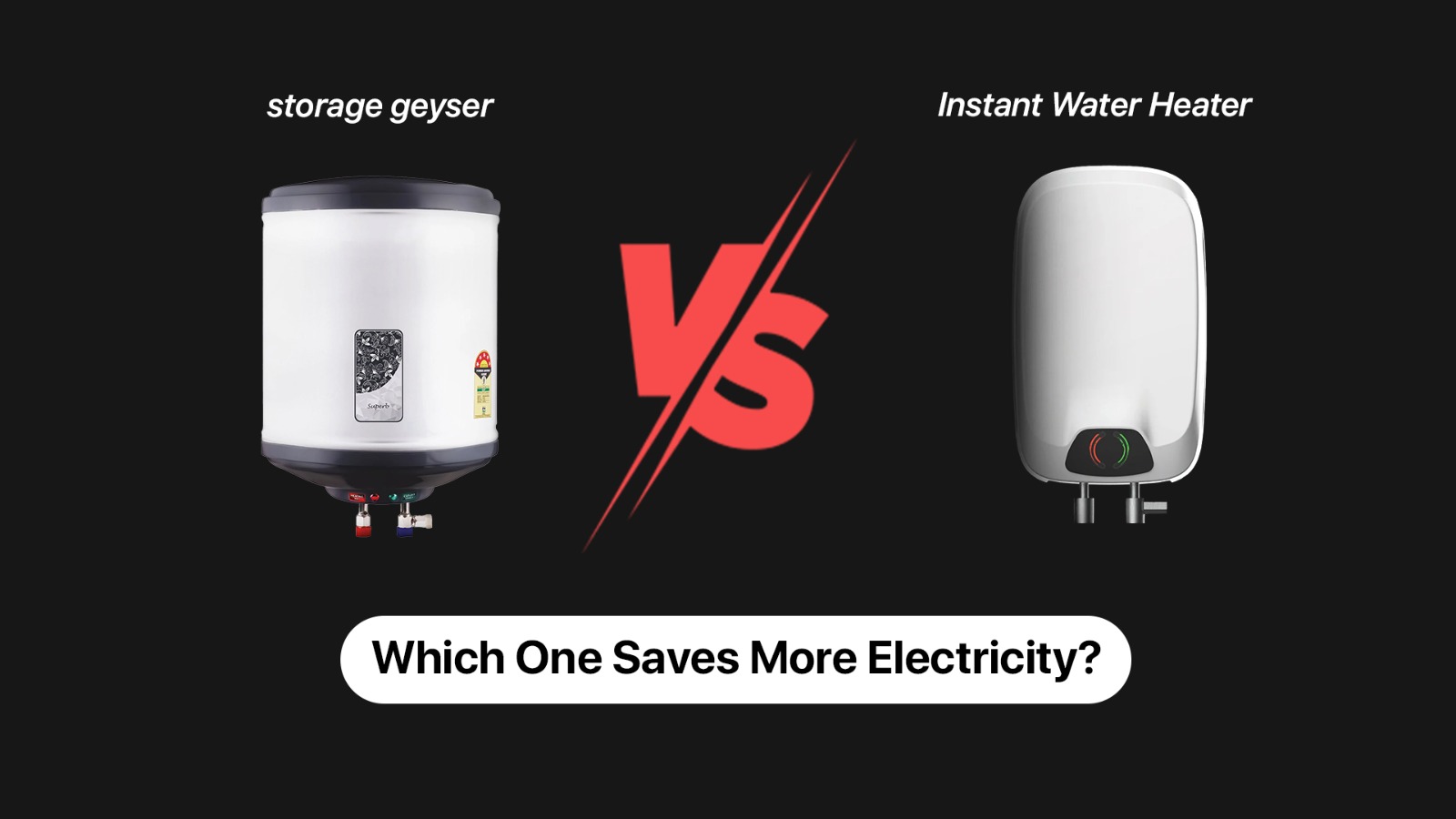
Geyser (Storage Water Heater)
A geyser has a built-in storage tank ranging from 6 to 30+ liters.
Here’s how it works:
- It fills the tank with cold water
- The heating coil warms the water to the set temperature (usually 40–75°C)
- The water remains stored and insulated
- Hot water is ready whenever you open the tap
✔ Gives continuous water for long showers
✔ Great for families
✔ Stable temperature
Downside:
It consumes small amounts of electricity to keep stored water warm -called standby heat loss.
Instant Water Heater (Tankless)
Instant heaters have no storage tank. They heat water as it flows through the device.
- When you turn on the tap
- Water passes through a high-power heating element
- It instantly heats the water
- Hot water comes out within seconds
✔ Instant, unlimited water supply
✔ No standby heat loss
✔ Small, compact, space-saving
Downside:
Flow rate is limited.The water may feel less hot if pressure is too high.
2. Electricity Consumption- A Detailed Comparison
This is where most customers get confused. It’s natural to assume Instant heaters = less electricity and Geysers = more electricity. But that’s not always true.
Electricity usage depends on how many people are using, shower duration, temperature, and frequency.
Let’s compare deeply.
Power Rating: Instant vs. Geyser
- Instant water heaters:
3 kW to 5.5 kW (higher wattage because water must heat instantly)
- Geysers:
1.5 kW to 2 kW typically (lower wattage but they run longer)
So instant heaters consume more power per minute, but for less time.
3. Real-Life Electricity Usage Scenarios
Let’s compare both with simple examples.
Scenario 1: 1–2 people, short showers
Hot water needed: 5-7 minutes per person
Instant Heater:
- Running time: 5 min × 2 = 10 minutes
- Consumption: 10 minutes × 5 kW = 0.83 units/day
Geyser:
- Heating time: 12–15 minutes
- Standby loss: 10–15%
- Total: ~1 to 1.2 units/day
👉 Winner: Instant Water Heater
For light usage, instant heaters clearly consume less.
Scenario 2: 4–5 people in a family
Hot water needed: back-to-back showers
Instant Heater:
Water temperature drops if multiple people use it back-to-back. Also, the heater runs longer.
Total usage: ~20–30 minutes
Consumption: 0.30–0.45 units per session
Daily use: 1–1.2 units/day
Geyser (15–25 liters):
Heats once → used by multiple members
Total: 0.8–1 units/day
👉 Winner: Geyser
For medium to large families, geysers become more efficient.
Scenario 3: Kitchen usage only
Dishwashing 3–5 times/day (short bursts)
Instant Heater:
Runs for 1-2 minutes each use
Total daily: 5-10 minutes
Consumption: 0.1-0.2 units/day
Geyser:
Not practical
Higher wastage
👉 Winner: Instant Water Heater
4. Electricity Saving Summary Table
|
Household Size |
Best Choice |
Why? |
|
1 person |
Instant | Zero standby loss |
|
2 persons |
Instant | Short usage, faster heating |
|
3–4 persons |
Geyser 15–20L |
Shared heating saves electricity |
|
5+ persons |
Geyser 25–30L |
Efficient for repeated usage |
| Kitchen Only | Instant |
Very low energy consumption |
👉 Winner: Instant Water Heater
5. If You Want to Save Electricity, Follow These Tips
✔ Set temperature between 50–55°C-Higher temperatures waste energy.
✔ Insulate water pipes-Prevents heat loss.
✔ Turn off the geyser when not needed-Avoids standby heating cost.
✔ Use a timer plug-Automatically switch the geyser off after heating.
✔ Prefer bathing with a bucket (for geyser users)-Saves up to 30–40% electricity.
6. Which One Should YOU Buy? (Based on Life Situations)
Do you live alone or with one other person?
Buy Instant Water Heater
- Low electricity usage
- Fast heating
- Compact
You have a family of 3-5?
Buy Geyser (15-25L)
- One-time heating for all
- Stable hot water
- Long-lasting
Do you need hot water in the kitchen?
Instant Heater
- Quick on/off
- No wastage
Which One Saves More Electricity?
Instant water heaters save more electricity if:
✔ You live alone or in a small family
✔ You take short showers
✔ Usage is limited to one or two people
✔ You need hot water instantly in small bursts
Geysers save more electricity if:
✔ You have a family with multiple people
✔ You take longer showers
✔ Usage is back-to-back
✔ You want consistent hot water without drops in temperature
In short, for low usage use Instant Heater and for heavy usage use Geyser. Both can save money but only when matched to the right household type.