Inverter vs Non-Inverter AC in Bangladesh: Is Paying Extra Really Worth It?
If you’re shopping for an AC on Pickaboo Bangladesh right now, you’ve probably noticed something confusing:
- Midea 1.5 Ton Non-Inverter: ৳44,990
- Midea 1.5 Ton Inverter: ৳52,990
Same brand, same cooling capacity, but ৳8,000 price difference. Your first instinct? “Why would I pay ৳8,000 extra for the same thing?”
This is the #1 question I get from Bangladeshi AC buyers. And the answer isn’t simple—it depends on your usage, budget, and priorities. Today, I’m breaking down inverter vs non-inverter ACs with real data, actual Pickaboo prices, and Bangladesh-specific electricity calculations.
By the end, you’ll know exactly whether that ৳8,000 extra is the smartest money you’ll ever spend—or a waste.
What’s the Actual Difference? (Explained Simply)
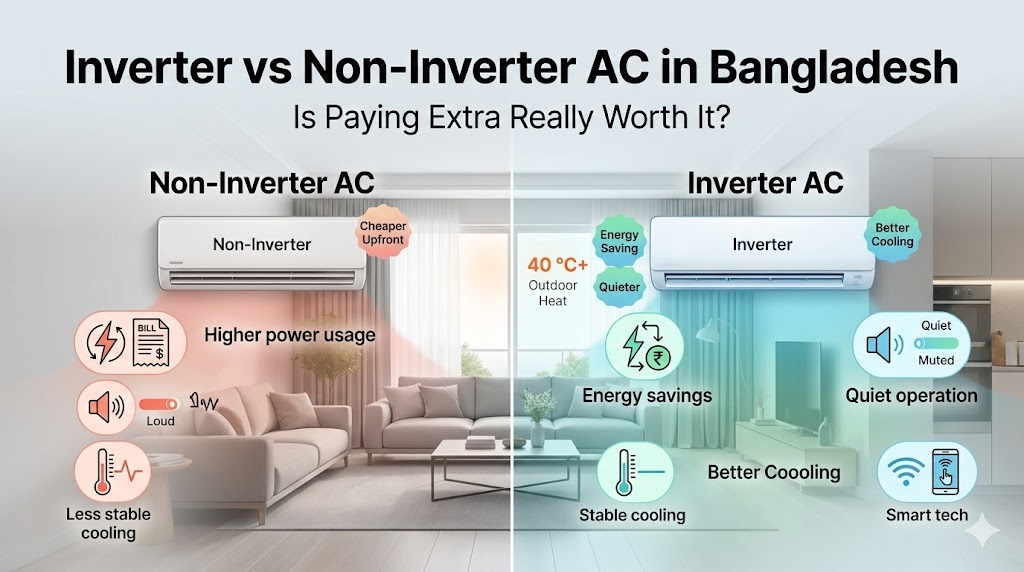
Non-Inverter AC: Traditional Technology
Think of it like driving a car with only two pedals: full accelerator or full brake.
How it works:
- Compressor turns ON at 100% power
- Cools room to set temperature (24°C)
- Compressor turns OFF completely
- Room heats up again (27°C)
- Compressor turns ON at 100% power again
- Repeat this cycle 100+ times per day
The problem: Starting/stopping uses massive electricity. It’s like constantly accelerating a car from 0 to 60 km/h—you burn fuel fast.
Inverter AC: Smart Technology
Now imagine driving with smooth acceleration—never stopping completely, just slowing down when needed.
How it works:
- Compressor starts at 100% power
- Cools room to set temperature (24°C)
- Compressor slows down to 30-40% power (doesn’t turn off)
- Maintains temperature by running continuously at low speed
- If room heats up, compressor speeds up slightly
- Never fully stops, never wastes startup energy
The benefit: Running at 30% power continuously uses far less electricity than repeatedly starting/stopping at 100%.
The Real Cost Comparison: Bangladesh Scenario
Let’s use actual Pickaboo prices and Bangladesh electricity rates (average ৳10/unit).
Scenario: 1.5 Ton AC, Used 10 Hours Daily (Typical Bangladesh Home)
| Factor | Non-Inverter | Inverter | Difference |
| Purchase Price (Pickaboo) | ৳44,990 | ৳52,990 | ৳8,000 more |
| Monthly Electricity (Units) | 480-520 units | 280-320 units | 180 units less |
| Monthly Bill | ৳5,000 | ৳3,000 | ৳2,000 saved |
| Annual Electricity Cost | ৳60,000 | ৳36,000 | ৳24,000 saved |
| 5-Year Electricity Cost | ৳3,00,000 | ৳1,80,000 | ৳1,20,000 saved |
The ROI Calculation: When Do You Break Even?
Initial Extra Cost of Inverter: ৳8,000
Monthly Savings: ৳2,000
Payback Period: 8,000 ÷ 2,000 = 4 months
What this means:
After just 4 months, the inverter AC has paid for itself. Every month after that is pure savings.
Over 5 years (typical AC lifespan):
- Total spent on non-inverter: ৳44,990 (purchase) + ৳3,00,000 (electricity) = ৳3,44,990
- Total spent on inverter: ৳52,990 (purchase) + ৳1,80,000 (electricity) = ৳2,32,990
You save ৳1,12,000 over 5 years by choosing inverter.
But Wait—These Scenarios Change Everything
❌ When Non-Inverter Might Make Sense:
Scenario 1: You Use AC Only 2-3 Hours Daily
If you only run AC briefly (like cooling room before sleep, then turning off):
- Monthly bill difference: ৳600-800 only
- Payback period: 10-12 months
- Over 5 years, savings: ৳30,000-40,000
Verdict: Still better to buy inverter, but the advantage is smaller.
Scenario 2: You’re Buying AC for Temporary Use (1-2 Years)
Example: Renting apartment for 18 months, will sell AC when leaving.
- You’ll only save ৳36,000 in electricity over 18 months
- But you paid ৳8,000 extra
- Net benefit: ৳28,000
Verdict: Inverter still wins, but barely. If you get better resale value for inverter, it’s worth it.
Scenario 3: Your Budget is EXACTLY ৳45,000 (Can’t Stretch)
You have ৳45,000 cash, no credit card for EMI.
- Non-inverter: ৳44,990 ✅ You can buy
- Inverter: ৳52,990 ❌ You can’t afford
Verdict: Buy non-inverter now, upgrade to inverter later when budget allows. Having an AC beats suffering in heat while saving for inverter.
✅ When Inverter is ABSOLUTELY Worth It:
Scenario 1: You Run AC 8+ Hours Daily (Most Bangladeshi Families)
During Ramadan, summer, or if someone works from home:
- AC runs 10-12 hours daily
- Monthly savings: ৳2,000-2,500
- Payback: 3-4 months
- This is a no-brainer investment
Scenario 2: You Plan to Keep AC for 5+ Years
Long-term ownership = maximum savings.
- 5-year electricity savings: ৳1,20,000
- Even if inverter AC costs ৳10,000-12,000 more, you still save ৳1,00,000+
Scenario 3: Electricity Rates Might Increase
Bangladesh electricity prices have risen 15-20% over last 3 years. If rates increase further:
- Current ৳10/unit might become ৳12-13/unit by 2028
- Inverter savings increase proportionally
- Non-inverter becomes even more expensive to run
Beyond Money: Other Inverter Advantages
1. Better for Bangladesh’s Unstable Power Grid
Non-Inverter Problem:
During load shedding, when power returns, the compressor tries to restart at 100% power—this damages the unit over time and trips circuit breakers.
Inverter Advantage:
Gradual startup protects compressor. Models like Walton Intelligent Inverter have built-in voltage protection (150V-260V range).
2. Longer Lifespan
Non-Inverter: Constant on/off cycles wear out compressor faster (typical life: 5-7 years)
Inverter: Smooth operation reduces mechanical stress (typical life: 8-10 years)
Replacement Cost Avoided: ৳50,000-60,000 (buying new AC 2-3 years earlier)
3. More Consistent Cooling
Non-Inverter: Room temperature fluctuates between 22°C-27°C (uncomfortable)
Inverter: Maintains steady 24°C (exactly what you set)
Benefit: Better sleep quality, especially important during Ramadan for Sehri/Iftar recovery rest.
4. Quieter Operation
Non-Inverter: Loud “clunk” sound every time compressor starts/stops (disrupts sleep)
Inverter: Near-silent operation after initial cooling
Benefit: Perfect for bedrooms, study rooms, or if you have infants/light sleepers.
Real User Experiences from Pickaboo Bangladesh
Non-Inverter User (Midea 1.5T MSG18CRN – ৳44,990)
⭐⭐⭐ “Works but bills are high” – Tanvir H., Mirpur
“Bought this because it was cheapest 1.5 ton option. Cooling is fine, but my DESCO bill jumped from ৳3,000 to ৳8,200 per month (running 12 hours daily during heat wave). Wish I had saved ৳5,000 more and bought inverter version.”
Inverter User (Haier 1.5T CleanCool – ৳54,990)
⭐⭐⭐⭐⭐ “Paying for itself every month” – Fariha K., Dhanmondi
“Initially hesitant about ৳55K price, but after 6 months I’m so glad I chose inverter. My electricity bill is only ৳3,400/month even with 10-hour daily use. My neighbor has non-inverter, same room size, pays ৳5,600. I’m saving ৳2,200 monthly!”
The Ultimate Decision Matrix
Use this table to decide:
| Your Situation | Recommendation | Why |
| Use AC 8+ hours daily | INVERTER | Pays back in 3-4 months, saves ৳1,20,000 over 5 years |
| Budget under ৳45,000 | NON-INVERTER | Buy what you can afford, upgrade later |
| Temporary use (1-2 years) | INVERTER | Still saves ৳30,000-40,000 even short-term |
| Use AC only 2-3 hours | INVERTER | Smaller savings but still positive ROI |
| Frequent load shedding area | INVERTER | Voltage protection crucial, avoids compressor damage |
| Long-term ownership (5+ years) | INVERTER | Maximum savings, better lifespan |
Bottom line: Unless you’re on extreme budget (under ৳45K), inverter is the smart choice.
Actual Pickaboo Models to Compare
Best Non-Inverter Option (If Budget is Tight):
Midea 1.5 Ton Non-Inverter (MSG18CRN)
Price: ৳44,990
Monthly Bill: ৳4,800-5,200
Best For: Absolute minimum budget, temporary use
Best Inverter Options (Worth the Extra Cost):
Budget Inverter:
Walton 1.5T Riverine Prime Inverter
Price: ৳49,990 (+ Free Installation)
Monthly Bill: ৳3,000-3,500
ROI: 3.5 months
Premium Inverter:
Haier 1.5T CleanCool Inverter
Price: ৳54,990
Monthly Bill: ৳2,800-3,200
ROI: 4 months
How to Afford Inverter If Budget is Tight
Option 1: Use Pickaboo 0% EMI
Instead of paying ৳52,990 upfront:
- 6-month EMI: ৳8,832/month
- 12-month EMI: ৳4,416/month
Since you’re saving ৳2,000/month on electricity, your effective cost is only ৳6,832/month (6-month EMI) or ৳2,416/month (12-month EMI).
Option 2: Save ৳1,000/Month for 8 Months
If you’re buying in advance:
- Save ৳1,000 monthly from Jan-Aug
- Buy inverter AC in August before next summer
- Total saved: ৳8,000 (enough to upgrade from non-inverter to inverter)
Final Verdict: Is Inverter Worth It?
For 90% of Bangladeshi families: YES
The ৳8,000 extra pays for itself in 4 months and saves ৳1,12,000 over 5 years. Even if your budget is tight, 0% EMI makes inverter affordable at just ৳8,832/month.
Only buy non-inverter if:
- Your absolute maximum budget is ৳45,000 and you can’t get EMI
- You’re buying AC for less than 12 months’ use
- You use AC less than 3 hours daily
Otherwise, the inverter AC is the best investment you’ll make this summer.
Shop inverter ACs on Pickaboo.com with EMI options, free installation, and official warranty today!